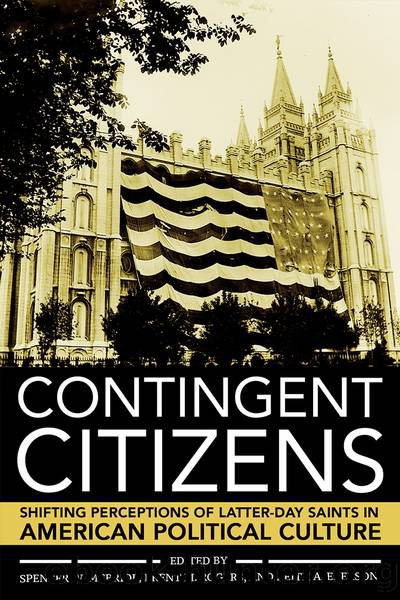
Contingent Citizens by Spencer W. McBride
Author:Spencer W. McBride
Language: eng
Format: epub
Publisher: Cornell University Press
Published: 2020-02-28T00:00:00+00:00
PART III
Unity and Nationalism
Mormons have presented the potential to disrupt the political and cultural unity of the American nation. Church leaders possess the religious authority to mobilize the faithâs adherents within the American democratic landscape and many of them have, in fact, exercised this political influence. This ability to assemble and affect is not unique to Latter-day Saints, but the faithâs centralized ecclesiastical structure and its self-expressed differences from other religious and regional groups have heightened fears that the Church of Jesus Christ of Latter-day Saints and its members could disrupt national unities.
The four chapters in Part III unpack the changing ways that Latter-day Saints have participated in conversations about national unity within the nationâs wider context of ever-shifting national needs, emerging alliances, and existing party structures and systems. On the eve of the Civil War, the Mormon quest for statehood threatened a fragile pact that attempted to balance slavery and antislavery factions within existing states and an expanding western frontier. In the twentieth century, American political rhetoric drew a hard line between godly American capitalism and ungodly Russian communism, prompting questions from within and without about the churchâs place and allegiance. As the culture wars of the late twentieth century reshaped party affiliations and issues, the faith again faced questions about its alignment with mainstream religion and politics.
Matthew Mason, the biographer of the renowned antebellum public intellectual Edward Everett, analyzes a stream of Mormon-themed correspondence between the Boston Brahman and the speaker of the US House of Representatives, John C. Winthrop. Everett opposed admission of a Mormon-dominated state but considered its advancement from territorial status inevitable. Mason contextualizes Everettâs position as part of an overall suspicion toward religious zealotry and charismatic religious leaders. Everett looked askance at Latter-day Saints from the point of view of both his Unitarian background and his moderate Whiggery, and as such he represented a larger cultural and political persuasion. But he also wrote within the broader context of the sectional and partisan debates leading to the Compromise of 1850. In that setting, he worried about what he saw as the churchâs history of stirring up strife everywhere they lived, something best not incorporated in territorialâand eventually stateâform in an already overly fractious Union.
Rachel St. John places the Latter-day Saint political experience within a broader landscape of shifting political identities and allegiances in the middle decades of the nineteenth century. After being granted territorial status, Utahans proclaimed their devotion to the US Constitution, served as government officials, and facilitated overland travel and settlement in the West. Yet this was also the period in which the church came closest to political independence, developing separate and semiautonomous economic, political, and military institutions in the Great Basin. This history of divided loyalties and ambivalence about the United States has often made the Mormon experience seem like an aberration. But it was not. Nineteenth-century North America was filled with people who, like the Saints, were in the process of puzzling out the relationship between their political allegiances, identities, and ideals.
Download
This site does not store any files on its server. We only index and link to content provided by other sites. Please contact the content providers to delete copyright contents if any and email us, we'll remove relevant links or contents immediately.
| Africa | Americas |
| Arctic & Antarctica | Asia |
| Australia & Oceania | Europe |
| Middle East | Russia |
| United States | World |
| Ancient Civilizations | Military |
| Historical Study & Educational Resources |
Cat's cradle by Kurt Vonnegut(15380)
Pimp by Iceberg Slim(14536)
4 3 2 1: A Novel by Paul Auster(12418)
Underground: A Human History of the Worlds Beneath Our Feet by Will Hunt(12106)
The Radium Girls by Kate Moore(12042)
Wiseguy by Nicholas Pileggi(5801)
The Fire Next Time by James Baldwin(5458)
Perfect Rhythm by Jae(5419)
American History Stories, Volume III (Yesterday's Classics) by Pratt Mara L(5316)
Paper Towns by Green John(5201)
Pale Blue Dot by Carl Sagan(5019)
A Higher Loyalty: Truth, Lies, and Leadership by James Comey(4974)
The Mayflower and the Pilgrims' New World by Nathaniel Philbrick(4511)
The Doomsday Machine by Daniel Ellsberg(4497)
Killers of the Flower Moon: The Osage Murders and the Birth of the FBI by David Grann(4454)
The Sympathizer by Viet Thanh Nguyen(4403)
Too Much and Not the Mood by Durga Chew-Bose(4359)
The Borden Murders by Sarah Miller(4336)
Sticky Fingers by Joe Hagan(4210)
